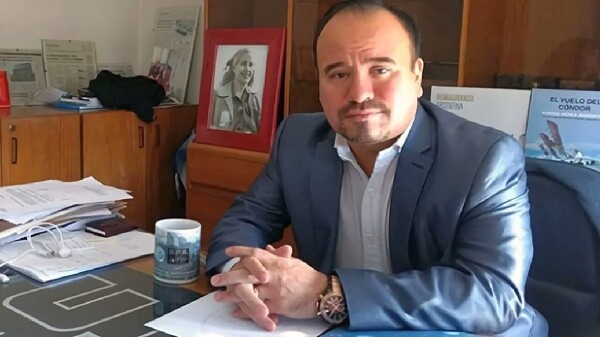
After a decade of flirting with the center-right, in a journey that led him to be nothing less than a presidential candidate for Mauricio Macri, national deputy for Encuentro Federal Miguel Pichetto has set out to retrace his path back to Peronism, convinced that nothing good can come from the libertarian government, and that the hackneyed and so often failed recipe of the 'middle way' is a lost cause. The strange thing about the case is that after having been functional to the setups that confronted Peronism in each of the elections from 2017 to the present, he now decides to return to the PJ, but not with a tired horse, but pretending to mold Peronism to his own measure, on his own terms. Pichetto calls it a 'national center front' based on a 'productive capitalism', far from the 'old scheme of interventionism and a present state', as learned by the Noticias Argentinas news agency. Peronism, chameleonic as few political movements in Latin American history, already wore those skins in the time of Eduardo Duhalde. 'In those years the best laws for the expansion of rights came out,' he stated in dialogue with the Noticias Argentinas news agency. Another national deputy from the kirchnerist Peronist wing stated in statements to NA that Pichetto 'brings a space for growth to the right', and ventured that his inclusion could attract 'conservative governors who always play according to how the wind blows'. 'Miguel doesn't bring votes, but he can help us grow to the right, which is a space we have neglected. For example, one cannot promote dangerous ideas that imply that a dollar worth 1,500 suddenly becomes worth 3,000,' he highlighted. In this context, he asked for 'a deep debate' as was done in the '80s with the 'renewal' promoted by Antonio Cafiero, Carlos Menem, José Manuel De la Sota and Carlos Grosso, which implied 'leaving an authoritarian model to move to a democratic one and be a party of the system'. From the meeting with Pichetto, Cristina Kirchner took note with the utmost attention. For some time now, she has entered a self-reflective process, of rethinking the political model that Peronism has to offer society in the mirror of new citizen demands, even challenging some self-evident truths in the national and popular field. The diverse views of Peronism on Pichetto's return In Peronism, many look with suspicion at Pichetto's return, who comes from voting for the Juvenile Penal Regime of the Government, and in the first year of Milei's government accompanied in Parliament almost without a word, even raising his hand in favor of the Bases Law. Some kirchnerist leaders, after the surprise summit at San José 1111, had to improvise approval, although most took refuge in silence. In the 'Movement for the Right to the Future', referenced by Governor Axel Kicillof, the positions range from indifference to absolute rejection. It makes sense: Pichetto is a fierce critic of Kicillof. About the Buenos Aires Aires governor, he recently said that if 'he wants to consolidate himself as a national alternative, he must change course in politics and the economy'. In La Cámpora, the energy is focused on wearing down Kicillof, who in recent months has become a much more attractive target than Pichetto, even though it was he and not the governor who systematically defenestrated kirchnerism in the last decade. Just as the organization led by Máximo Kirchner reconciled with Guillermo Moreno because it is functional to its endless internal struggle with Kicillof, the same logic could be applied to Pichetto, another who can become a battering ram to sharpen it. National deputy Eduardo Valdés, a Peronist with good access to Cristina Kirchner, came out to welcome the Encuentro Federal deputy and celebrated the meeting he had with the former president. 'How am I not going to agree with his return if I believe that Argentina's happiest years since Perón were when Cristina was president and Miguel was head of the Senate bloc? There is nothing 'modern' in the veteran deputy's proposal. Nevertheless, coming from the outside after long years of voluntary exile, Pichetto seeks to rewrite and give a 'modernizing' sense to a Peronism whose leadership has given it since 2003 a statist imprint, of strong fiscal intervention and expansion of consumption, a hyper-progressive agenda, open migration, broad social policies, and articulation with popular movements. Everything that Pichetto despises. After the event he shared with Guillermo Moreno and after voting against Javier Milei's labor reform, Cristina Kirchner invited him to a meeting at her home on San José 1111, where she is serving her prison sentence, to exchange impressions on the current political situation. There, who was the head of the Senate bloc throughout the 'Won Decade' (2003-2015), proposed to the former president to converge in a great national front with similar characteristics 'to what Lula built to face (Jair) Bolsonaro' in Brazil. Referring to the content of that talk, the legislator said that 'it was a fraternal meeting where the present and the future were spoken of, not the past'. 'Peronism needs a capitalist, productive, centrist proposal that gives predictability and guarantees to investors and economic agents.'